Competency-Based Healthcare Education
NSDC/HSSC Qualification Pack HSS/Q5101 aligned · Expert-reviewed · Rated 9.6/10
Three principles. One purpose: a caregiver who protects patients.
🏥 Clinical Competence
Every skill taught is a skill assessed. Every assessment is witnessed and signed by a qualified nurse. Memory fails under pressure — competency does not.
❤ Compassionate Care
Clinical correctness and human dignity are inseparable. We train both, simultaneously, in every session.
👔 Professional Conduct
Accountable, punctual, disciplined. Graduates escalate concerns without hesitation and refuse tasks outside their scope.
The most important sentence in any caregiver's training: when in doubt, tell the nurse. Not because you are weak — but because the nurse needs your eyes and ears to do their job. — CareBridge Curriculum, Week 1, Session 1
Traditional training produces certificates. CareBridge produces professionals.
Traditional GDA Training
- Classroom lectures only
- No clinical exposure
- No standardised assessment
- Certificate of attendance
- No placement system
- No post-placement follow-up
The CareBridge System
- 30% theory · 70% hands-on learning
- Supervised hospital clinical exposure
- OSCE — 8-station clinical examination
- QR-verified digital certificate
- Structured hospital placement
- Employer rating at Month 3 and Month 6
A CareBridge Certified Caregiver (CCC) walks into their first hospital shift with a signed Competency Logbook, an OSCE-examined credential, and the clinical instincts to observe, report, and act safely — from Day 1, not after weeks of hospital induction.
From Aspiration to Career
Every CareBridge candidate takes the same journey — and arrives at the same standard.
Admission
Orientation · Logbook issued · Pathway selected
Foundation
Week 1 · Safety · Professional identity
Skills Lab
Week 2 · Vitals · Transfers · Communication
Personal Care
Week 3 · Bed bath · Catheter · Feeding
Emergency
Week 4 · CPR · Stroke · Code Blue
Clinical
Hospital · Real patients · RN supervision
OSCE
8 stations · 40 marks · Objective assessment
CCC
QR certificate · Digital profile · Career begins
Every step is documented in the candidate's Competency Logbook — signed by a qualified Registered Nurse. This is not a shortcut programme. It is a standard.
Choose the pathway that fits your goal
NAPS Hospital Apprentice
For: Candidates placed as paid apprentices in partner hospitals
Duration: 4 weeks + 11 months NAPS
Outcome: CCC · Hospital placement · NAPS certificate · Career system
Clinical Practice
For: Candidates requiring supervised ward exposure before placement
Duration: 5 weeks
Outcome: CCC · Shantimohan clinical endorsement · Placement support
Home Care Specialist
For: Candidates entering the ₹2,400 crore home care market
Duration: 6 weeks
Outcome: CCC · Home Care Specialisation · CareBridge marketplace listing
Six-Module Architecture — Common Core
| Module | Theme | Key Skills | Hours |
|---|---|---|---|
| 1 | Safety & Professional Identity | Hand hygiene · Hospital hierarchy · Escalation culture · Infection control | 40 hrs |
| 2 | Observation & Safe Movement | Vital signs · SBAR communication · Patient transfers · Falls prevention | 40 hrs |
| 3 | Essential Personal Care | Bed bath · Oral care · Catheter care · Feeding assistance | 40 hrs |
| 4 | Special Care Populations | Elderly care · Dementia communication · Palliative care | Integrated |
| 5 | Emergency Response | Adult CPR (BLS) · Choking · Seizure care · Stroke (FAST) | 40 hrs |
| 6 | Professional Mastery | Simulation bank · OSCE examination · CCC certification | Integrated |
Hour Distribution — How We Train
| Training component | Hours | % of programme | What happens |
|---|---|---|---|
| Classroom theory | 48 hrs | 30% | Only what cannot be learned by doing |
| Skills laboratory | 52 hrs | 32.5% | Hands-on manikin and peer practice |
| Simulation / role-play | 24 hrs | 15% | Unannounced scenarios · Clinical reasoning |
| Ward clinical exposure | 30 hrs | 19% | Supervised real patient contact |
| Assessment & OSCE | 6 hrs | 3.5% | Objective examination and logbook sign-off |
Caregivers do not learn to care for patients by reading about patients. They learn by practicing with manikins, being coached by qualified nurses, and eventually caring for real patients under supervision.
Four learning environments. One outcome: genuine competency.
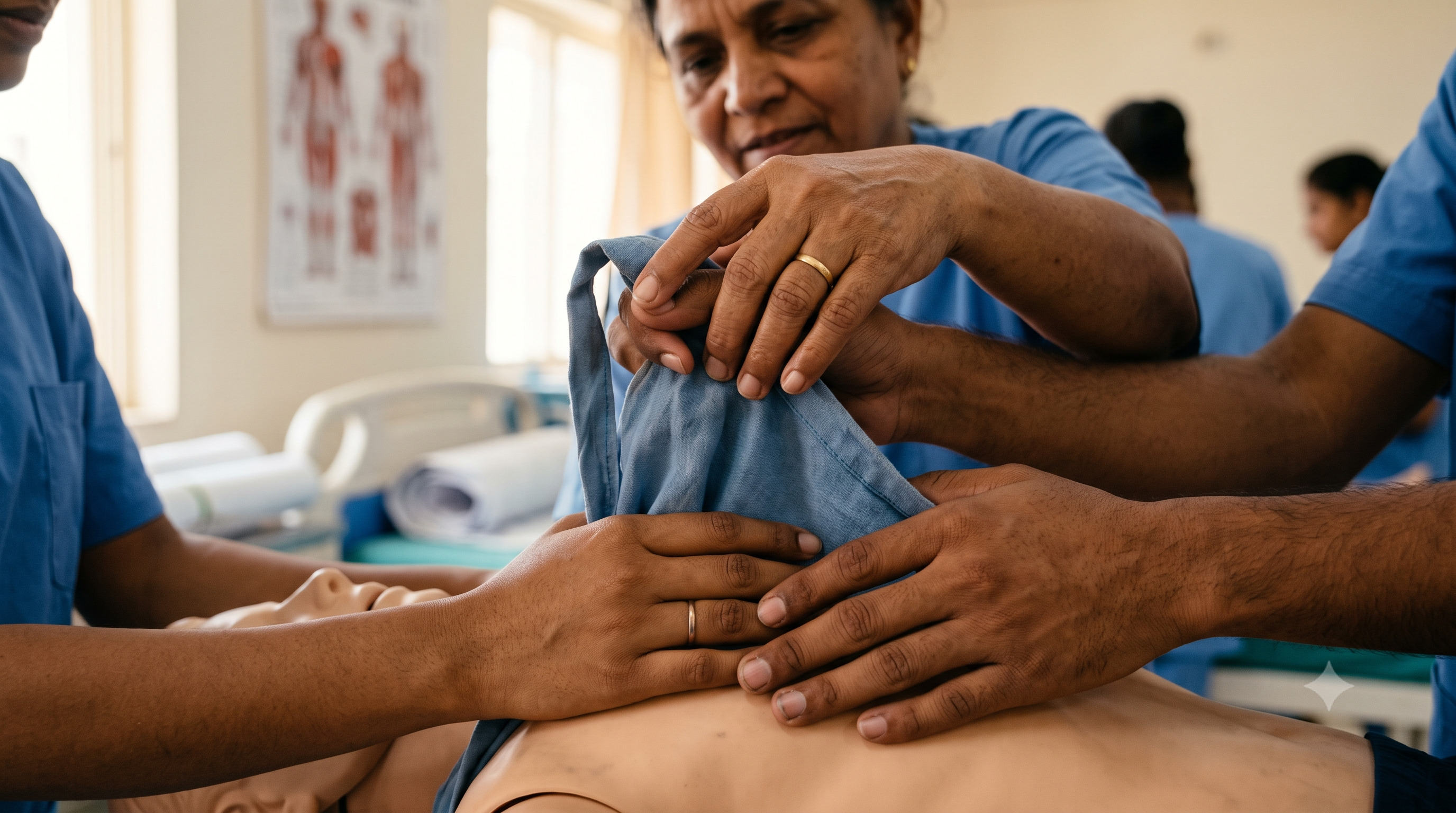
Skills Laboratory
Replicates a hospital ward environment. Candidates practice on manikins before touching real patients — blood pressure, bed baths, CPR, and transfers, until body mechanics become instinctive. Skills are signed off only when the instructor has directly observed correct performance.
Simulation — Unannounced Scenarios
Week 4 includes eight unannounced emergency scenarios. A candidate may be mid-exercise when the trainer announces "Code Blue — Bed 4." No preparation is possible. Only genuine competency produces the right response — the closest approximation to real ward conditions classroom training can achieve.
Clinical Ward Exposure
Every candidate spends supervised hours in a real hospital ward, beginning with Week 1 observation at Shantimohan Hospital, Nagpur. By Week 3, candidates perform personal care on real patients under direct RN supervision — their logbook signed by the ward Registered Nurse, not a CareBridge trainer.
Role-Play & Professional Behaviour
CareBridge trains for situations most GDA programmes ignore: a family member offering a gift, a doctor who shouts, a patient who becomes abusive. Candidates practice the correct response until it becomes instinctive — because in a real ward, you will not have time to think.
We do not assess what candidates know. We assess what they can do.
The Competency Logbook
Every candidate carries a printed A5 Competency Logbook from Day 1 through certification, covering 40 clinical skills. For each skill, the candidate demonstrates three progressively independent levels: Observed (watches the trainer perform it), Assisted (performs with trainer support), and Done (performs independently, directly observed and signed by an instructor or RN). It is a legal competency record — not a self-declaration.
The OSCE — Objective Structured Clinical Examination
8 stations, 47 minutes total, 40 marks. Each station assesses a different clinical skill through direct observation against a pre-defined marking criteria.
| Station | Skill Assessed | Minutes | Marks |
|---|---|---|---|
| 1 | Vital Signs — BP and SpO2 | 5 | 6 |
| 2 | Patient Transfer — Bed to Chair | 7 | 6 |
| 3 | Hand Hygiene — WHO technique + 5 Moments | 4 | 4 |
| 4 | SBAR Communication | 5 | 5 |
| 5 | Dementia Communication | 6 | 5 |
| 6 ⚠ | CPR — MANDATORY PASS | 10 | 8 |
| 7 | Documentation — Fluid Balance + Turning Chart | 5 | 4 |
| 8 | Pressure Area Assessment | 5 | 4 |
Station 6 — CPR — is a mandatory pass. A candidate who fails CPR fails the entire OSCE, regardless of score elsewhere. Non-negotiable: a caregiver who cannot perform CPR cannot safely enter a hospital ward.
The Digital Certificate — QR-Verified
Every CCC carries a QR code linking to their live CareBridge portal profile. Any hospital administrator can scan the certificate and verify in real time: OSCE result, logbook completion, employer ratings, and renewal status. No other Indian caregiver certification can be verified this way.
Hospital-Ready Graduates — Eight Competency Domains
🩺 Clinical Observation
BP, pulse, temperature, SpO2, RR to clinical standard. NEWS2-aware. SBAR reporting.
🗣 SBAR Communication
All four SBAR components delivered in under 90 seconds, without notes.
🤲 Personal Care
Bed bath, oral care, catheter care to RN-witnessed standard, with dignity maintained.
🚑 Emergency Response
BLS-certified CPR. Code Blue response within 60 seconds. Stroke and seizure management.
📋 Clinical Documentation
Fluid balance charts, turning charts, incident reports — accurate, never fabricated.
🛡 Infection Control
WHO 6-step hand hygiene to automaticity. Standard and transmission-based precautions.
♿ Safe Patient Movement
Correct body mechanics for all transfers. Fall risk assessment and prevention.
❤ Dementia & Elder Care
Validation and redirection. Sundowning management. End-of-life comfort care.